Why Some Providence County Yards Can’t Support a Standard Drain Field
If a site evaluation came back recommending something other than a conventional field, it wasn’t an upsell — it was almost certainly one of five specific, checkable conditions common in this part of Rhode Island.
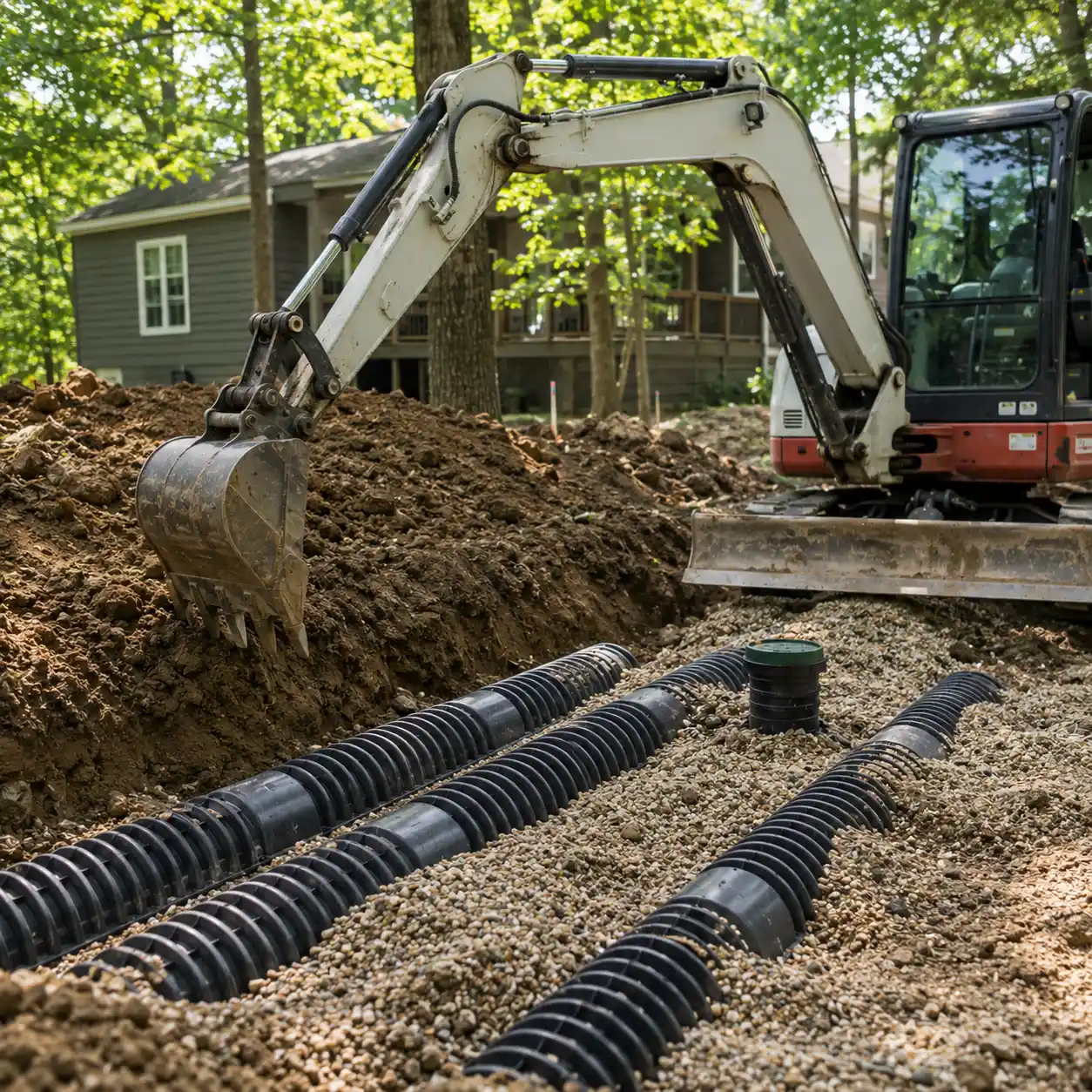
“My Neighbor Has a Regular System — Why Don’t I?”
This comes up more than you’d think, usually after a site evaluation comes back recommending a mound system or a pressure-dosed field instead of a standard gravity trench layout — and the price along with it. It can feel arbitrary, especially when a house two streets over clearly has a conventional setup. It isn’t arbitrary. A handful of specific, physical site conditions determine what a lot can actually support, and Providence County has more than its share of them.
None of these conditions are things a designer invents to justify a bigger job. They’re things RIDEM’s soil testing and design review process is specifically built to catch, because a conventional field installed where one of these conditions exists tends to fail early — which costs far more than doing it right from the start.
1. Shallow Bedrock, aka Ledge
A conventional field needs a certain depth of usable soil below the trenches before it hits bedrock — that soil is what’s actually filtering the effluent. In parts of western Providence County, especially out toward Scituate, Foster, and Glocester, granite ledge sits close enough to the surface that there simply isn’t room for a standard trench design. When that’s the case, a mound system solves it by building additional soil depth up and above grade instead of trying to dig down through rock that isn’t going anywhere.
2. A High Seasonal Water Table
Groundwater that rises too close to the trench bottom during wet parts of the year creates the same fundamental problem as shallow ledge — not enough clean soil between the effluent and the water it’s supposed to be filtered before reaching. This shows up more in low-lying areas and closer to the Bay, where the water table can shift noticeably between a dry August and a wet April. A site evaluation typically checks this at the wettest reasonable point in the year specifically so the design doesn’t fail the first spring after installation.
Not sure what your lot can actually support?
A site evaluation tells you before you’re stuck guessing at a design.
Schedule a Site Evaluation
Serving Providence and all of Providence County.
3. Undersized or Oddly Shaped Lots
A lot of Providence County’s older, denser neighborhoods were platted long before modern septic sizing rules existed. Once you account for setback distances from the house, property lines, wells, and any nearby water features, some lots simply don’t have enough contiguous, usable space left for a conventional field’s footprint. A pressure-dosed system can sometimes fit a smaller or more irregular area more efficiently than a gravity-fed layout can.
4. Proximity to Wetlands, Wells, or Water Bodies
RIDEM’s design rules require specific setback distances between a drain field and any nearby wetland, drinking water well, or surface water body — the exact distance depends on what’s nearby and, in some parts of the state, whether the property sits within a protected watershed area. Where those setbacks eat significantly into the buildable area, an engineered system that concentrates dispersal into a smaller footprint is often the only way to make the numbers work on that specific lot.
5. Poorly Draining Soil Pockets
Glacial till left Rhode Island’s soil with a lot of local variation — a property can have well-draining, sandy soil in one corner and a dense, slow-draining clay pocket twenty feet away. Percolation testing during the site evaluation is what actually catches this, since it’s not something you can tell by looking at the surface. Slow-draining soil needs either a larger field footprint to compensate or, if the space isn’t there, an alternative system that doesn’t rely purely on soil absorption the same way.
What This Means for Your Design
None of these conditions mean a lot can’t be developed — they just mean the system has to be matched to what’s actually there instead of assuming a generic layout will work. The cost difference between a conventional field and an alternative system is real, but it’s driven by the ground itself, not by which contractor you happen to call.
If you’re planning new construction, replacing a failed system, or just curious why your property came back with an unexpected recommendation, a straightforward site evaluation is what actually answers the question — not a guess based on what the house next door has.
Find Out What Your Lot Can Actually Support
Fill out the form and we’ll schedule a site evaluation — soil testing, groundwater check, and a straight answer about what your property needs before we ever talk design.
- Soil testing & groundwater evaluation
- Ledge & setback assessment
- Conventional & alternative system design
- RIDEM permitting handled for you
- Clear cost breakdown before design work starts
- Serving all of Providence County
Tell Us About Your Needs
We’ll reach out to confirm your appointment details.